
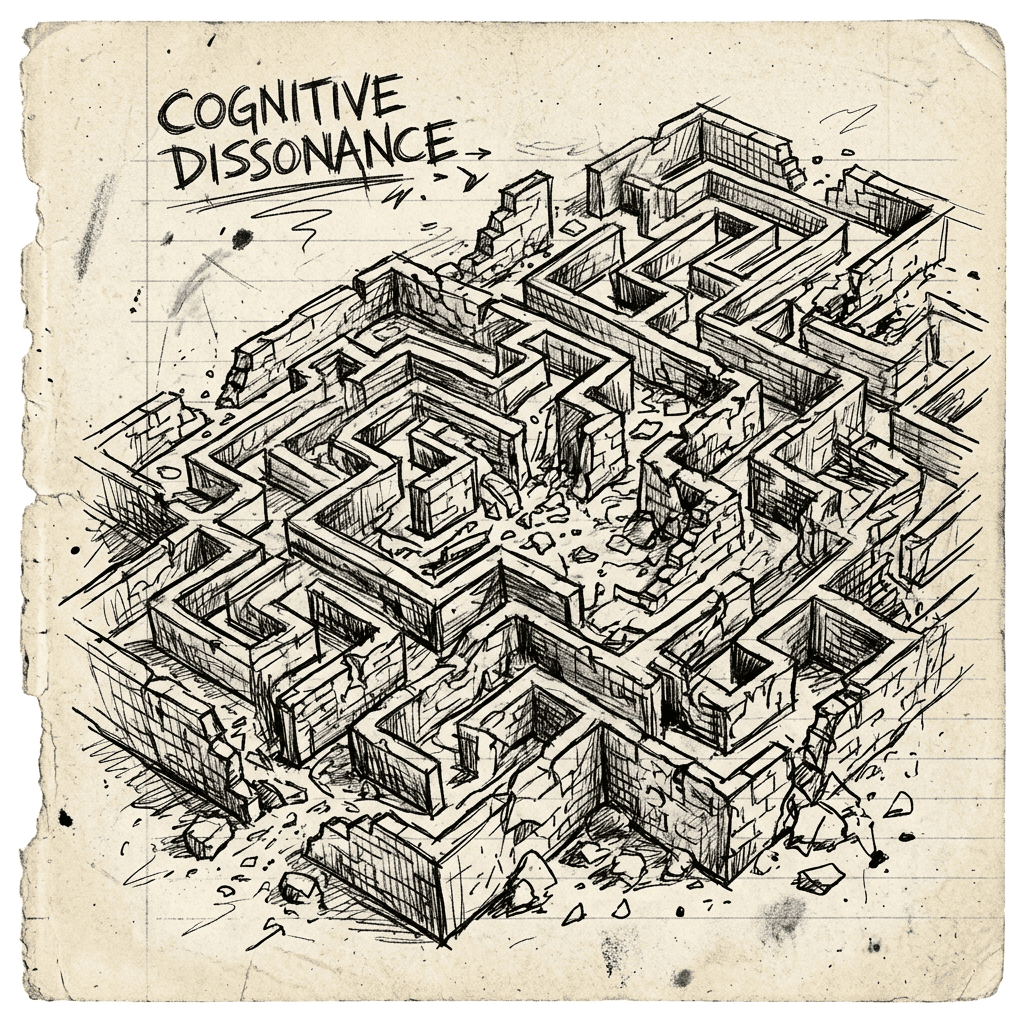
We descend incontinenti towards one of the most captivating and insidious mirages of the human intellect: the Petition of Principle, immortalized in the Latin codices as Petitio Principii. The Stagirite Aristotle, guided by the light of natural understanding, unraveled this deviation in his Sophistic Refutations, defining it as the illegitimate usurpation of the unacknowledged premise, consisting of postulating from the outset or taking for granted that which constitutes the contentious and obscure point that was intended to be demonstrated. We are not faced with a lack of expository elegance, but rather with the abolition of logical progress: one pretends to advance towards an unknown knowledge when in reality one turns sterilely around one's own starting point.
Cognitive neurobiology analysis describes this disorder as a closed feedback loop in which the medial prefrontal cortex is isolated from empirical verification and anesthetized with a false sense of internal coherence. Vitiated dogmatism incurs this epistemological heresy through two main paths. The first runs through the so-called vicious circle or tautological dialectic, where the premise and conclusion exhibit a substantial identity dressed in synonyms or diverse grammatical clothing; He is the archetype of someone who maintains that opium extract puts the sufferer to sleep thanks to its soporific virtue, and when asked what this virtue consists of, he claims without shame that it is the natural power to induce sleep. The second path, even more harmful in the judicial and journalistic forum, is executed when the arguer establishes a conclusion on an opinionable, controversial and unproven proposition that he dogmatically presents as an incontrovertible principle. In the inquisitorial sociology of modern progressivism, this maneuver crystallizes in the perverse sentence of someone who, upon seeing a magistrate or a political adversary subjected to judicial persecution, sentences that if he has been prosecuted it is because he has committed some crime, recklessly assuming in the premise the material guilt that the court was justly called upon to examine. As the illustrious Logic of Port-Royal warned, here we commit the absurdity of trying to clarify a darkness by appealing to a mystery of equal or greater darkness.
The field of public debate very frequently degenerates from circular sterility into the blatant hijacking of collective attention through the False Herring Fallacy, an artifice that British intelligence immortalized under the name Red Herring or smoky herring. This ruse of parliamentary and media deception consists of disguising the inconsistency of one's own premises or the overwhelming evidence of the rival by throwing a collateral issue into the foreground, unrelated to the core of the dispute but loaded with an affective virulence capable of dragging the interest of those present. The peasant tradition of England observed that poachers, to mislead the fine sense of smell of the packs of hounds in pursuit of the fox, dragged along the trails an intensely cured and fragrant herring; The dog, intoxicated by the penetrating stimulus, abandoned the legitimate trail of its prey to stray after the mirage.
The physiology of the ascending reticular activating system and the cerebral amygdala reveals that human understanding is extremely vulnerable to the sudden impact of sentimental drama. The consummate sophist knows by psychological calculation that the urban crowd—exhausted in its analytical cortex—shuns the austere effort of deductive examination, but reacts with instant ardor to moral indignation, tragic mourning, or collective vituperation. If in a parliamentary deliberation on the technical deficiencies of a procedural code or the fiscal legality of an expropriation, the prevaricating minister stands up to shout at the opponent if he is perhaps insensitive to the suffering of the four thousand orphans who cry out for bread in the suburbs, the rationality of the room is annulled on the spot. The trickster has hijacked attention, has wrapped himself in the priestly garb of compassion and has turned a trial of legality into a contest of feelings where anyone who demands documentary rigor will be condemned as an uncharitable monster.