
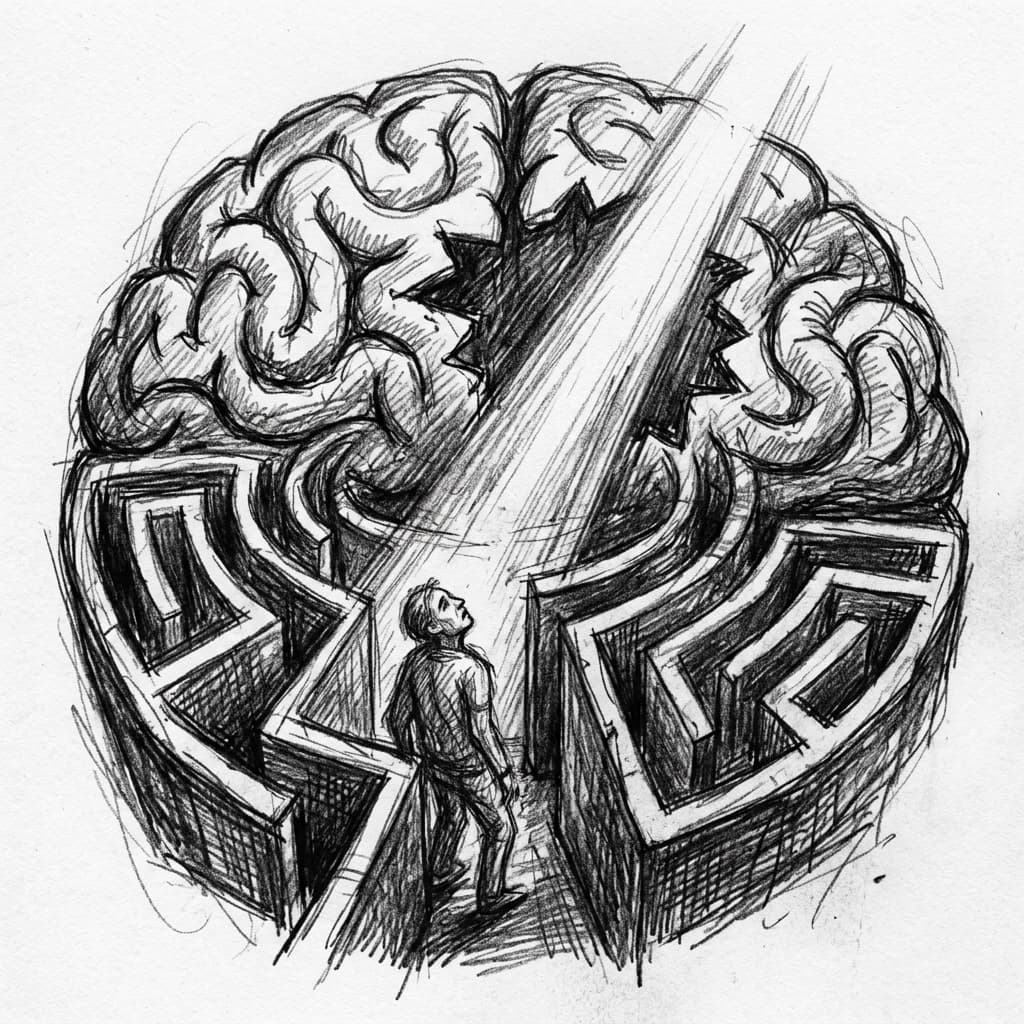
Begin with the word, because the word already contains the problem. The defense press has described what happened at US Cyber Command as a suicide cluster: a grouping, an aggregation, a term epidemiology uses with perfect propriety to describe the anomalous concentration of cases in space and time. Applied to men, the term performs a quiet and perverse labor: it converts five unrepeatable biographies into a statistical anomaly, implies contagion where there were decisions, and moves the matter from the ground where it happened — the conscience of a person — to the ground where it becomes administrable, which is the curve. They are not a cluster. They were five men and women with names, trades, parents, in several cases children, who over roughly five weeks between early June and early July of this year stopped being able to bear the weight of being alive. On September 3, military leaders will brief the House Armed Services Committee. Someone, in the meantime, ought to put the question a congressional committee is almost never positioned to put, because it cannot be answered with a line item.
The institutional facts are public and sufficient to locate the problem. The dead served directly in Cyber Command or worked closely alongside it, within a small ecosystem where people know one another; the workload has multiplied over the past year because of overseas conflicts, including operations against Iran. The House committee has called the rise in deaths a critical issue and the Senate is discussing expanded mental health resources with the command. It is also known that the problem was identified well before this summer: Congress ordered a study of the psychological strains peculiar to this force in 2023, and a 2025 defense law required the command to field dedicated mental health specialists, including counselors cleared to hear from personnel who handle classified information. And there is one figure worth committing to memory, because it describes a hierarchy of values more precisely than any speech: against an annual budget exceeding four billion dollars, the request for the human sustainment of the operators — the unfunded priority submitted by their commander — came to eleven million. Special Operations Command spends something on the order of eighty million a year on comparable programs. The proportion is the argument.
But the institutional diagnosis, necessary as it is, stops far too early. It says: clinical staff are lacking, clearances are lacking, an embedded model of care is lacking. All of that is true and all of it is insufficient, because it describes as a service-delivery gap what is in strict terms a deprivation of another order. What these people lack is not merely an available professional. It is the entire structure that for millennia allowed a human being to do what war demands and afterward return to his own table without breaking. That structure had four parts, and this trade — by its own nature, not by anyone's negligence — has abolished all four. Each deserves separate examination, because their absence holds the explanation no hearing is going to supply.
The first part is the threshold. Every culture that has sent its sons to fight has marked the boundary with a rite: one departs, one crosses a line, one is there, one returns. The classical military cycle — reconstitution, training, deployment, demobilization — is not bureaucratic whim but the administrative translation of an ancient wisdom: a man needs to know when he begins and when he ceases to be the one who kills. The cyber operator is, in the technical phrase, deployed in place: he spends two or three years conducting real-world operations without leaving the installation, and every evening he drives home. At nine in the morning he takes part in an operation that may darken a facility on the far side of the planet; at seven in the evening he argues with his daughter about homework. There is no crossing, no uniform to take off, no port of arrival. Conscience, which is slow and requires transitions, is compelled to inhabit two incompatible worlds with no frontier between them. He is asked, in practice, to be two men in the same day, and neither is permitted to know the other.
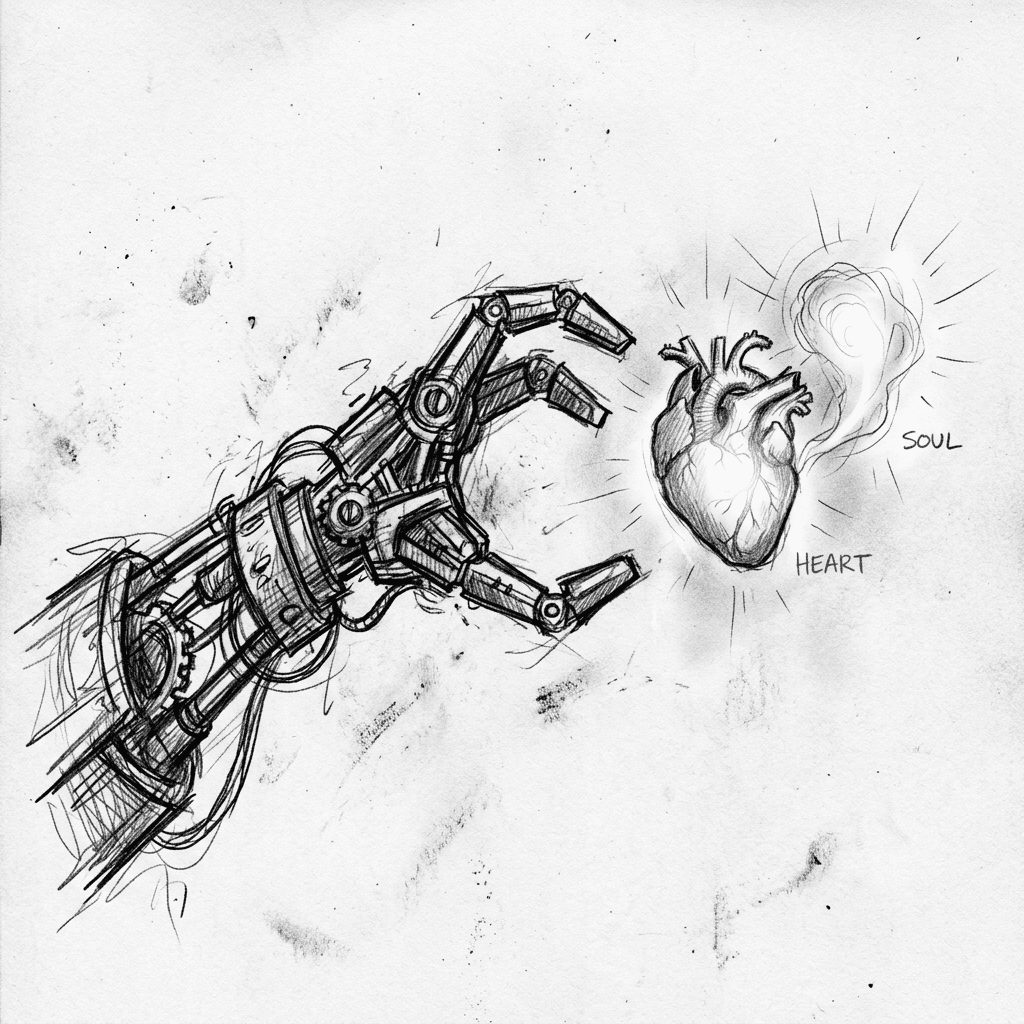
The second part is the body, and here lies the anthropological error propping up the whole edifice. It has been tacitly accepted that an operation conducted by digital means is an act of intelligence only, a technical exercise without bodily implication and therefore without moral residue. This is false, and false in the least expected direction. Man is not a mind piloting a machine of flesh: he is a unity, and whatever he does he does entire. The soldier who sees the effect of his act receives, along with the horror, a measure: there is smoke, there is a cry, there is a wound, there is proportion between what he did and what followed, and that proportion — terrible as it is — lets conscience locate the act, weigh it and, in time, carry it. The screen offers no measure. It returns a confirmation of execution and no image; and where perception supplies no limit, imagination fills the gap, and imagination has no floor. The operator is not spared the weight of his act by not having seen it. He is defenseless before it, because he must imagine it without ever being able to check whether his imagination overstates or falls short. Distance does not purify the act. It merely withdraws the data by which the soul might have governed it.
The third part is speech, and it is the most gravely amputated. Man is the animal that heals by naming: he knows himself by what he says, unburdens himself by what he confesses, and is reintegrated into the community by the telling of what befell him. The entire Western tradition of the care of souls — from sacramental confession to the veteran's testimony over a long dinner — rests on an assumption so elementary it was never stated: that someone is permitted to listen. The cyber operator has no such person. His clearance, legitimate and necessary, forbids him to describe his work to his wife, his brother, his oldest friend; and until very recently it forbade him to describe it precisely to the physician and the chaplain as well, because the person about to listen lacked the accreditation required to hear what he was talking about. Let the reader pause here, because the whole account contains no greater revelation: a statute had to be passed to grant these men an interlocutor legally capable of hearing them. The right to be heard, which no dying man of the twelfth century would have needed to petition anyone for, has become an eleven-million-dollar line item that went unfunded besides. A class of men has been constituted whose deepest experience is juridically unsayable, and then reproached, in the language of human resources, with a certain difficulty adjusting.
The fourth part is recognition. Military honor was always public, and not from vanity: the ceremony, the decoration, the visible scar and the parade discharged a precise moral function, which was to socialize the weight. A community that sends a man to do something terrible in its name contracts an obligation to bear publicly some portion of that act, and the rite was the mechanism of that sharing. Here there is none of it. There is no scar, no dispatch from the front, no city to applaud, because the city neither knows nor can be told. The act is performed in the name of all and its weight is deposited entirely in the conscience of one. It is externalization in its perfect form: the nation takes the strategic benefit and the individual absorbs, alone and unwitnessed, the whole moral cost. No psychology resolves that, because it is not a maladjustment in the person. It is a failure of distributive justice.
From this follows what this newspaper will argue in the second part of this study, and which we set down now so that our thesis is not mistaken for a lament. We do not say that cyber warfare is illegitimate because it is bodiless, nor that these people are doomed by the trade they chose; to say so would be to add despair to despair, and it would also be untrue. We say that they have been required to operate without the four conditions that make the use of force humanly bearable, and that the institutional answer — hire therapists, widen clearances, embed the care — is correct but pitched an order below the problem: mitigation measures applied to a deprivation of meaning. What is owed them, in addition to the clinicians and before them, is restitution of what was taken: a real threshold dividing the fighting day from the domestic evening; chaplains and physicians cleared as a matter of course rather than by exceptional statute, so that the wound may at least be named to someone; a doctrine that stops calling clean what is merely remote; and a public form of honor that shares the weight, even if it has to be invented from nothing for a war that cannot be recounted. None of this costs four billion dollars. And not one of the five people we are discussing was a data point: each was an entire world, unrepeatable and of incalculable worth, which no epidemiological curve manages to describe and which no operational urgency licensed anyone to spend.
Editor's note: if you, or someone close to you, are in the situation described here, professional help exists, it works, and asking for it is an act of strength rather than surrender. Free, confidential lines operate in nearly every country — 988 in the United States, 116 123 in the United Kingdom and Ireland, 024 in Spain — staffed around the clock by people whose whole occupation is to listen.
Legal Notice: This critical analysis is published under Art. 28 (news of general interest) and Art. 10 (right of quotation) of Law 11.723 on Intellectual Property of the Argentine Republic. The original work and its title belong to their respective author and publisher, both cited on this page.