
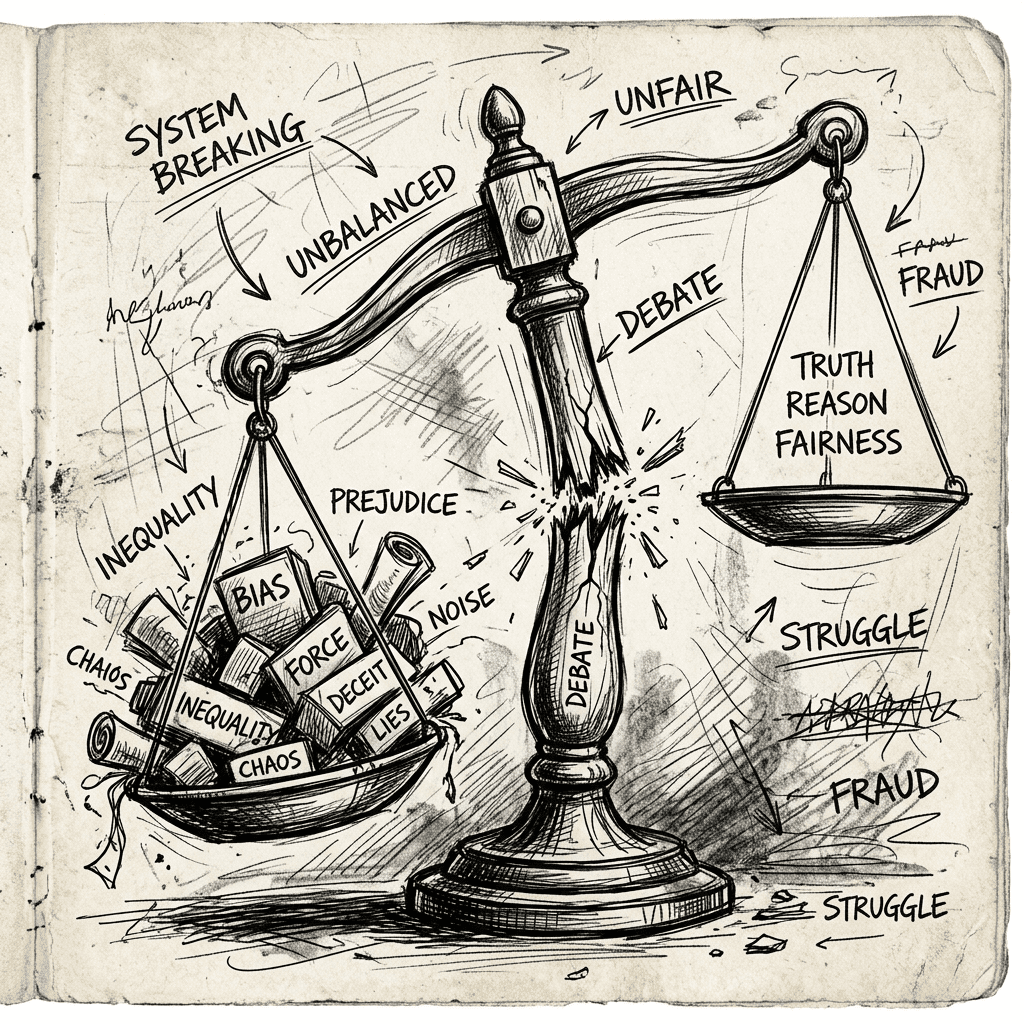
Connected to the contempt of the individual arises the Genetic Fallacy, a dialectical aberration that consists of judging the validity, truth or current merit of a person, an institution or a theory based exclusively on its historical origin, its founding circumstances or its remote past. Whoever denies the competence and present merit of a recognized scholar by arguing that in his early childhood he exhibited learning difficulties commits this offense. This reasoning violates the principle of human neuroplasticity and the mandate of moral regeneration; The brain matures, the neural networks are reconfigured through persevering study, and the soul is susceptible to redemption and spiritual progress. Sanctioning the present reality for the accidents or hardships of the origin represents a question-begging that denies the historicity of the living person and replaces the debate on the truth of current propositions with inquisitorial prejudice regarding the pedigree of the enunciator.
This perversion of analysis reaches its point of maximum social aggressiveness in the Argument ad Hominem, or attack on the person, where the scrutiny of ideas is completely renounced to try to overthrow the adversary by disqualifying his character, his intelligence, his religious faith or his social position. In its direct aspect, the attack outrages charity by rebuking the good faith of the sender, claiming that belonging to a Catholic confession, an economic school or a professional union disqualifies the person from articulating valid reasoning; Thus the perennial truth that the logical order is autonomous from the morality or circumstances of the speaker is ignored, fulfilling the adage according to which even an inert clock tells the exact time at two times of the day. In its insidious variant of poisoning the well, the manipulator disqualifies the interlocutor before he opens his lips, decreeing a prior censorship that prevents the audience from listening to reasons; and in its indirect or circumstantial form, an attempt is made to invalidate a technical study or a legal defense by arguing that the speaker represents particular interests, omitting that the presence of an interest does not suppress the logic of the argument if the premises are demonstrable and resist documentary evidence.
For its part, intellectual laziness takes refuge in the Fallacy ad Ignorantiam, the argument for ignorance codified in modern philosophy by John Locke, which seeks to consider the truth of an implausible statement proven for the sole reason that the adversary cannot reliably demonstrate its falsehood. The lazy understanding abhors the healthy prudence of suspending judgment in the face of the unexplored; He prefers to populate the mystery with esotericisms and superstitions, maintaining the existence of esoteric realities or unprovable conspiracies under the pretext that no one has presented proof of their mathematical impossibility. It is necessary here, to protect justice and lucidity, to establish a sharp demarcation with the legal field: the sacred presumption of innocence in procedural and canon law does not constitute in any way a fallacy due to ignorance, since it does not declare that the accused is morally immaculate, but rather establishes a prudential rule of protection to avoid the intolerable sin of condemning an innocent person as long as the accuser does not prove his guilt. The true and infernal application of the ad ignorantiam fallacy in the public scene is that of inquisitorial McCarthyism and collective hysteria, where the burden of proof is reversed and the suspected citizen is required to prove his innocence under threat of moral lynching, presuming his guilt based on the mere accusation.