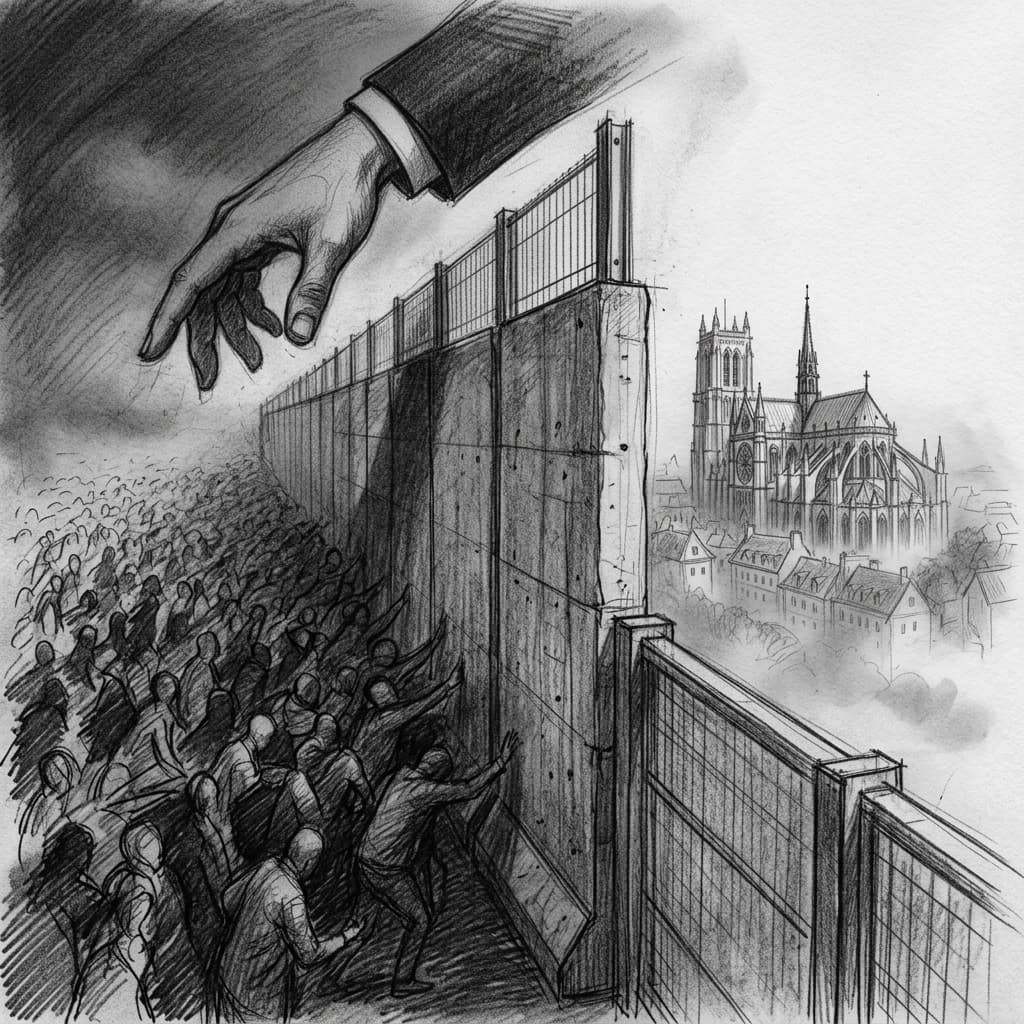
The summer of 2026 has provided us, once again, with the desolate spectacle of the border fracture in southern Spain. The human avalanches over the fences of Ceuta and Melilla are not, however, a mere unpredictable meteorological phenomenon, no matter how much the contemporary media machinery insists on portraying them as such. Observing the dissection that the mass press performs on this drama, a fascinating yet profoundly destructive cognitive pattern emerges: the contrast between the instrumentalized sentimentalism of outlets like El País and the statistical, almost notarial coldness of newspapers like El Mundo. Both seemingly antithetical approaches share a fundamental ontological blindness: they refuse to call things by their true name.
We cannot and must not betray our guiding principle. Christian mercy is not an aesthetic choice, but an absolute mandate. Every individual who throws themselves into the waters of the Mediterranean, or who tears their skin on the concertina wire, bears an inalienable dignity; they are the image and likeness of the Creator and, as such, constitute an ontological treasure that deserves profound charity, assistance, and respect. Aiding the dying, rescuing the shipwrecked, and feeding the hungry are imperatives that precede any modern constitution. However, there is an immense moral and intellectual abyss between the personal charity owed to a specific neighbor and the systemic surrender to an orchestrated social engineering process on a planetary scale. It is precisely in this gap that mercy has been maliciously hijacked.

What we face is not simply a "migration crisis," a sterilized term suggesting a passing event. We are witnessing a veritable industry of uprooting, a tool of sociological demolition employed by the architects of what is euphemistically called "global governance." The stateless technocratic elites, indifferent to the real pain of the migrant and deeply hostile to the historical roots of the West, foster and manage these flows not out of compassion, but out of convenience. The goal is not to integrate the foreigner into an organic community with shared values, but to liquefy the Nation-State, dissolve the religious and identity cohesion of the receiving societies, and generate an amorphous mass of uprooted consumers, with no loyalty to any land, any faith, or any tradition.
When media sentimentalism demands that we abolish borders in the name of a plastic humanism, it is, de facto, paving the way towards economic totalitarianism. A border is not an insult to humanity; it is the physical perimeter that guarantees the existence of a community with rights, duties, and a cultural legacy to transmit. The defense of the home, the preservation of ancestral customs rooted in Christianity, and the protection of the natural order do not constitute xenophobia, but an act of legitimate defense and elemental justice.
The right to emigrate, always conditioned by the host country's capacity to absorb, inexorably carries the moral duty to assimilate and respect the worldview of those who open their doors. But when the receiving elite itself, infected by the woke ideological matrix and moral relativism, forbids assimilation and demonizes Western heritage, social coexistence logically collapses. This condemns both the local, who loses their homeland, and the newcomer, who is thrown into a ghetto of perpetual marginality without solid moral anchors to hold onto.
The time has come to disarm the induced guilt with which globalist neo-paganism paralyzes our consciences. Charity demands loving the foreigner who knocks at the door, alleviating their suffering, and treating them as a brother in Christ. But the same charity, informed by prudence and reason, obliges us to relentlessly confront the invisible architects who strive to tear down the doors of our nations so they may reign, unopposed, over the ruins.