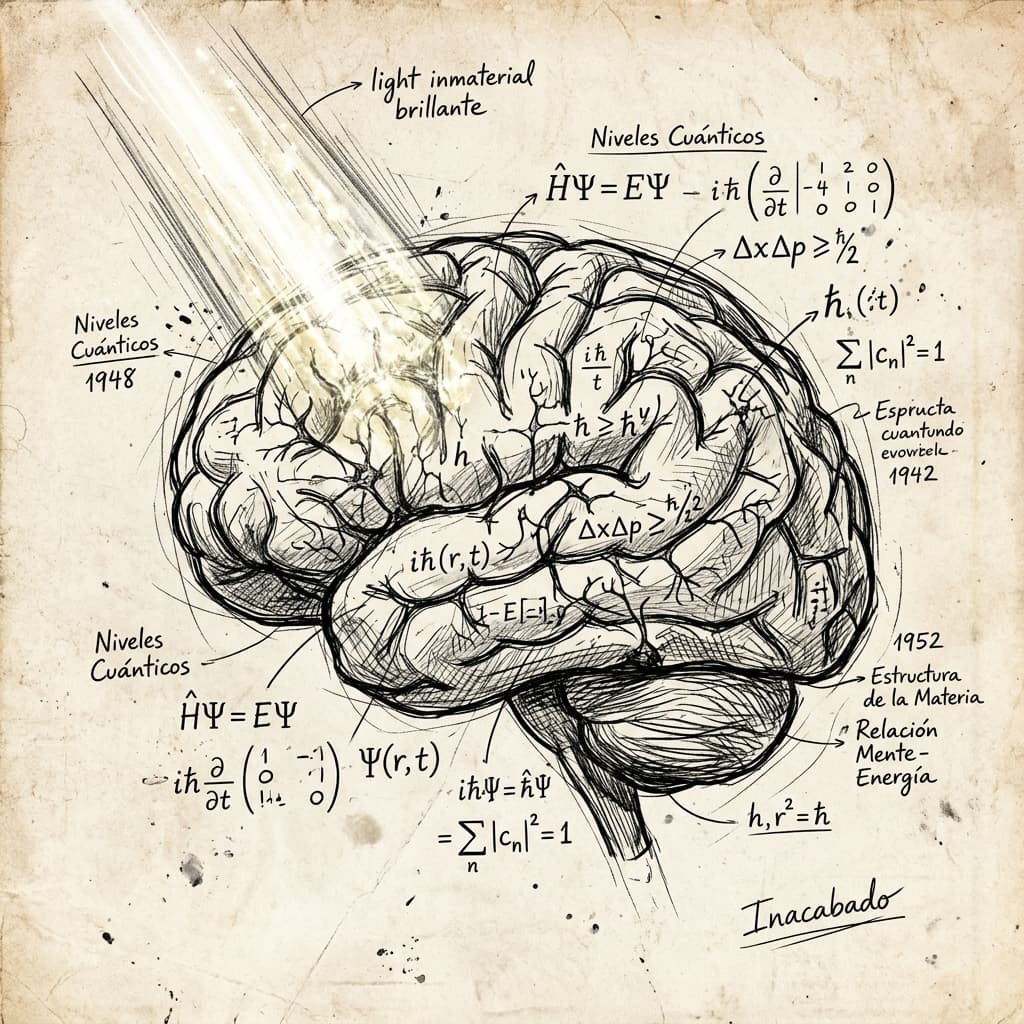
From Dr. María Victoria Ibáñez-Soto
A rigorous analysis of how quantum mechanics applied to neurobiology dismantles the reductionist model of consciousness, pointing towards the intrinsic immateriality of the intellect.
Our academic reading:
Modern science, trapped for centuries in the Newtonian mechanistic paradigm, has attempted to reduce the mystery of human consciousness to a mere sequence of electrical impulses and biochemical reactions. This neurological reductionism postulates that the human being is nothing more than a biological automaton, completely denying the existence of the soul, free will and any transcendent dimension of the person. However, recent advances in quantum biology have begun to crack the foundations of this dogmatic materialism, demonstrating that the laws of classical physics are insufficient to explain the phenomenon of self-consciousness.
At the center of this debate are neuronal microtubules, cylindrical protein structures that form the cytoskeleton of neurons. Far from being a simple cellular scaffold, recent research suggests that these structures function as information processors at the subatomic level, facilitating states of quantum coherence at room temperature. The theory of orchestrated objective reduction postulates that consciousness arises from coordinated collapses of quantum wave functions within these microtubules.
While materialist critics have argued for decades that the brain's warm, moist environment would cause almost instantaneous quantum decoherence, preventing any sustained quantum processing, new findings in two-dimensional spectroscopy have revealed the existence of long-lived phonon resonances in tubulin networks. These resonances act as protective shields, isolating quantum superposition states from ambient thermal noise. This isolation allows quantum information to be processed before collapsing, introducing an element of fundamental indeterminacy into neural decision-making.
The philosophical implication of this phenomenon is monumental and devastating for materialist atheism. If the synaptic activity preceding a conscious decision is subject to quantum indeterminacy, the strict deterministic causality model collapses. The brain ceases to be a predictable biological Turing machine and reveals itself as a quantum receptor or interface; an exquisitely tuned material instrument that allows an immaterial principle—the rational soul, in Aristotelian-Thomistic terms—to interact with the physical world without violating the laws of thermodynamics.
Free will, therefore, is not an illusion generated by the prefrontal cortex, but rather an immaterial first cause that determines the collapse of the wave function in the microtubular networks. This synchronization between the immateriality of the intellect and the plasticity of the biological quantum substrate underlines the profound truth of hylemorphic unity: the human being is a unique substance composed of matter and spirit, indissolubly united during earthly existence. Denying this reality in the name of obsolete scientism is not only an academic error, but an act of spiritual blindness that strips man of his intrinsic and infinite dignity.
*Legal Note: This critical analysis is carried out under the protection of Art. 28 (news of general interest) and Art. 10 (right of citation) of Law 11,723 on Intellectual Property of the Argentine Republic. The original work and its title belong to its respective author and publication medium, cited on this page.*
LEGAL NOTICE OF INTELLECTUAL PROPERTY AND FAIR USE
The editorial analysis and critical refutation constitute an original intellectual work by Editorial Santa Jacinta (DNDA Registry File No. RL-2026-42754029-APN-DNDA#MJ). The critical analysis of sources and the reproduction of extracts are carried out under the protection of Art. 28 (news of general interest) and Art. 10 (right to quote) of Law 11.723 on Intellectual Property of the Argentine Republic and the Berne Convention. Copyright over the original journalistic work belongs to Dr. María Victoria Ibáñez-Soto. properly linked. The partial informative quotation or reproduction of the editorial analysis is authorized, obligatorily citing the source («Editorial Santa Jacinta») with an active link to https://santajacinta.us/papers/quantum-decoherence-in-neuronal-microtubules-and-the-impossibility-of-materialistic-determinism.