
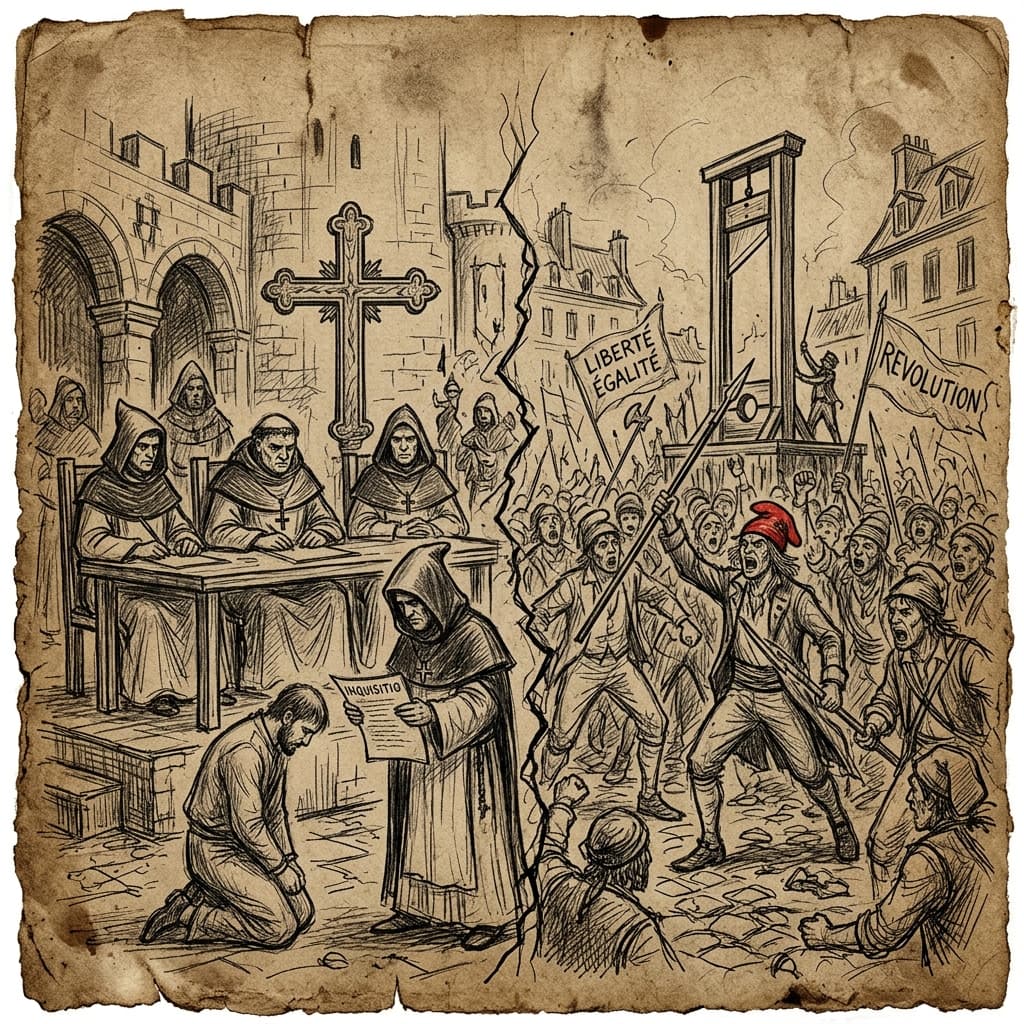
Beyond the overwhelming arithmetic disproportion, the true civilizational abyss that separates both historical experiences lies in the legal nature of their procedures and in the metaphysical conception of justice that guided their respective courts. While the revolutionary courts of the National Convention and the Committee of Public Safety of Robespierre, Couthon and Saint-Just operated under the ferocious Law of the Twenty-second Pradial of the Second Year, promulgated in June 1794, which eliminated with a stroke of the pen the right to have a defense lawyer, eliminated the preliminary investigation, abolished the hearing of defense witnesses and reduced the possible verdicts to the summary dilemma between the Unconditional absolution or immediate death on the scaffold, the Spanish Inquisition constituted, historically speaking, the most guaranteeing, meticulous and humanitarian court of justice in all of modern Europe. As the French historian Jean Dumont has argued with incomparable erudition in his works on Christianity and modernity, if a European citizen of the sixteenth or seventeenth centuries had to be tried for a serious crime, he would have begged on his knees to be placed at the disposal of the Castilian Inquisition and not of the imperial, English or Germanic civil courts. The paleographer of the University of Oxford Henry Kamen has shown in his great study on the Inquisition that the Holy Office required evidentiary rigor unparalleled in its time: every prisoner enjoyed the sacrosanct right to challenge judges for bias, to have a defense lawyer financed by the royal treasury, to present extensive lists of capital feuds that invalidated any adverse testimony by right and even to receive medical and hospital assistance. home. Anonymous complaints were strictly burned and rejected, and the procedural resource of torture—so morbidly and slanderously caricatured by Central European Protestant engravers—was applied in less than two percent of lawsuits, always for a strictly timed maximum of fifteen minutes, in the obligatory presence of a doctor and a notary, and under the absolute and non-derogable prohibition of spilling a single drop of blood, mutilating limbs, or causing permanent damage to one's integrity. corporeal nature of the individual, unlike the gruesome dismemberments and witchcraft bonfires without due process that consumed the lives of hundreds of thousands of women in the Calvinist, Lutheran and Anglo-Saxon territories of northern Europe.
The profound explanation of this procedural excellence is not fortuitous nor does it obey simple bureaucratic benevolence, but rather springs from the very heart of Catholic moral theology and Aristotelian-Thomistic natural law. For the Castilian inquisitors, trained with teaching excellence in the chairs of Salamanca, Valladolid and Alcalá de Henares, the procedural subject was never a statistical object, a disposable number or a hindrance to the utopian redesign of the citizen structure, but rather an ontologically valuable human person, endowed with a spiritual and immortal soul, redeemed by the Blood of Jesus Christ on the Cross and whose doctrinal error had to be corrected preferably through instruction, logical refutation, philological patience and penitential charity. Recourse to the secular arm of the State was reserved as a last painful ratio for cases of rebellious pertinacity that threatened the spiritual cohesion, civil concord and public order of the Christian Republic. On the contrary, for the Jacobin commissars and ideologists of the Enlightenment, imbued with the mechanistic rationalism and materialist monism that preceded the guillotine, the dissident was not an erring brother called to conversion, but an ontological traitor to the General Will, an antisocial plague and a biological obstacle to the construction of the new citizen conceived by Jean-Jacques Rousseau, deserving only of sanitary and industrial extermination. This confirms the unbreakable sociological and moral law that presides over our editorial line: when man abjures the true God and tries to build a heavenly city on earth by deifying the State or Reason, he invariably unleashes a technocratic hell that crushes the human being with limitless ferocity.