
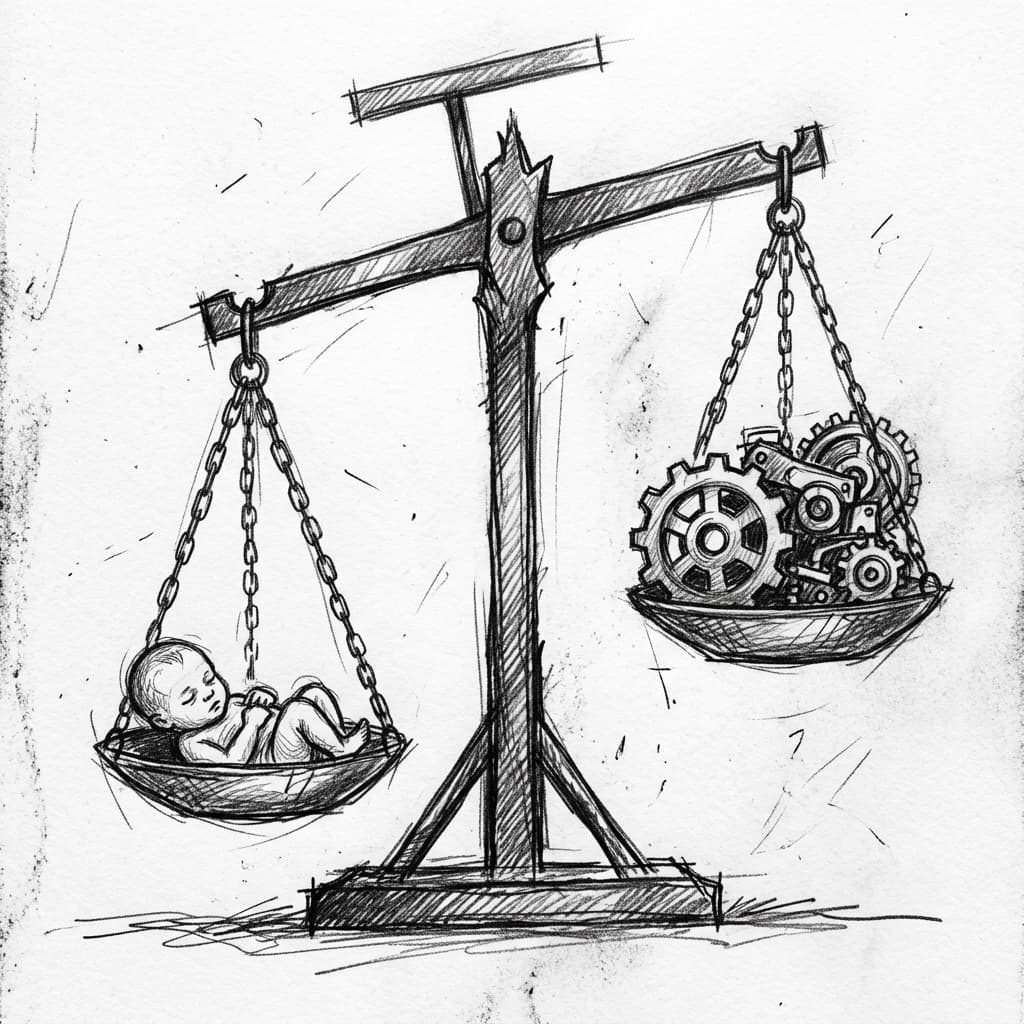
There is a new extractive industry operating on American soil, and its open-pit mine is the developing brain of the child. The euphemism under which it trades — the "attention economy" — deserves the same forensic suspicion we would apply to any commercial vocabulary designed to anesthetize moral perception. What is being bought and sold, in strict neurobiological terms, is the finite orienting capacity of the human person: the primordial act by which a soul turns toward one thing rather than another, and which every contemplative tradition of the West has recognized as the antechamber of prayer, of study, and of love. The average American adolescent now surrenders the better part of his waking day to devices whose engineers speak, without embarrassment, of "engagement" and "retention" — the argot of the fisherman describing his hook. That the fish in question are twelve years old has not, until recently, troubled the quarterly reports.
The neuroscience here is neither speculative nor contested in its fundamentals. The mesolimbic dopamine system — the circuit running from the ventral tegmental area to the nucleus accumbens — does not respond principally to reward, as popular accounts suggest, but to the prediction of reward, and above all to its uncertainty. This is why the variable-ratio reinforcement schedule, the same intermittency that Skinner documented in his pigeons and that casino architects perfected in the slot machine, is the load-bearing wall of every infinite scroll and every notification system. The "pull-to-refresh" gesture is a lever, and the payout is social approval delivered at unpredictable intervals. In the adolescent, this machinery meets a brain whose subcortical reward circuitry is fully operational while the prefrontal cortex — seat of inhibition, deliberation, and the ordering of ends — remains under construction into the middle twenties. To aim industrial-scale persuasion technology at such a brain is not competition for attention; it is the exploitation of a documented developmental asymmetry, and in any other domain of commerce we would call it what it is.
The collateral damage radiates outward through the architecture of the person. Short-wavelength light delivered to the retina at night suppresses melatonin secretion and delays the circadian phase precisely in the years when the adolescent clock is already biologically shifted later; the resulting chronic sleep debt degrades the consolidation of memory, the regulation of affect, and the synaptic housekeeping upon which learning itself depends. Meanwhile, the habit of perpetual interruption trains what researchers politely call attentional fragmentation: each task-switch exacts a measurable cost in reorientation, and a childhood spent switching becomes an adulthood incapable of the sustained, effortful, unrewarded attention that mathematics, craftsmanship, and the interior life all demand. The laboratory has thus confirmed what any Benedictine could have told us: attention is not a spigot but a discipline, a habitus built or squandered through repetition, and the platforms are running the largest habituation experiment in human history without consent forms.
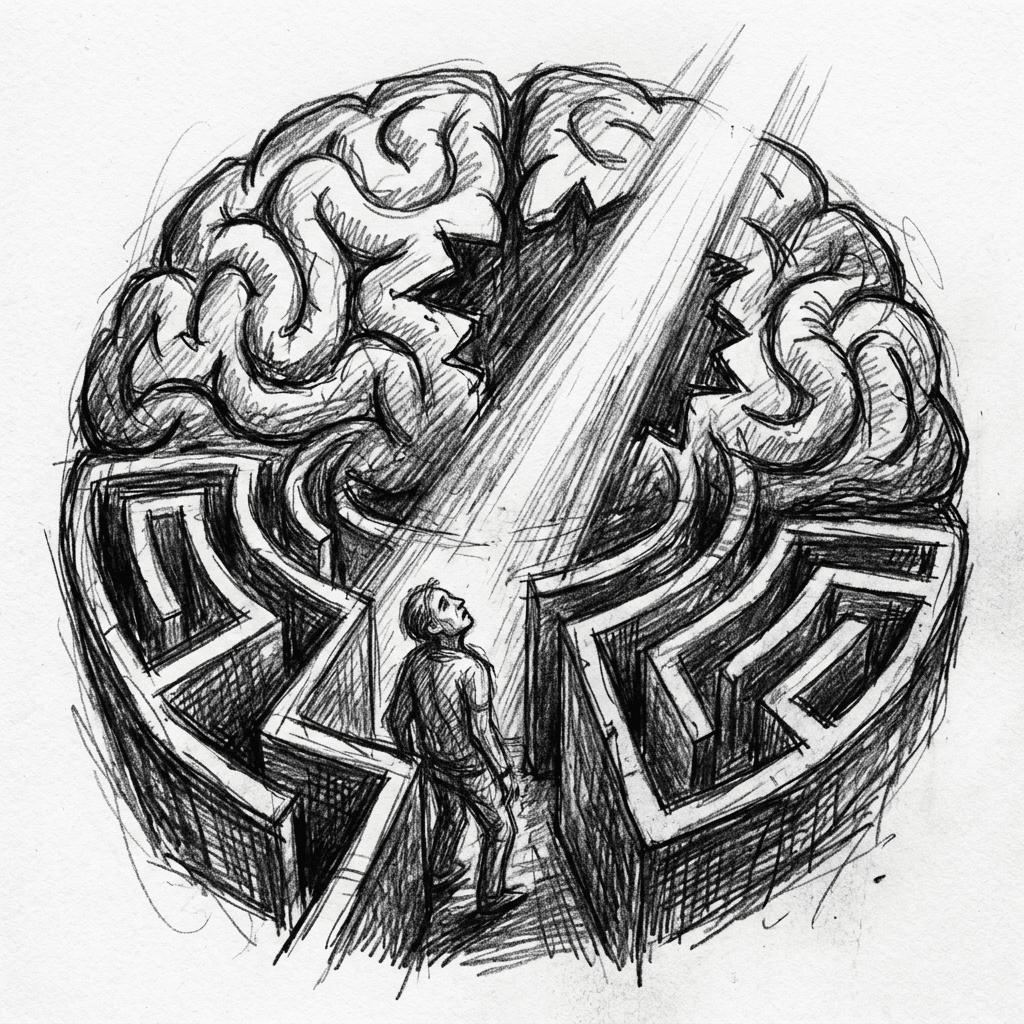
None of this is accidental, because all of it is remunerated. The platform economy does not sell software to families; it sells families to advertisers, and the unit of account is the captured minute. Every design decision — the autoplaying video, the ephemeral story, the streak that punishes absence, the algorithmic feed tuned by continuous experimentation upon its users — is optimized against a single fiduciary duty, owed not to the child but to the shareholder. Behind the adolescent alone in her bedroom stand thousands of engineers, psychologists, and machine-learning systems whose collective salary depends on her not looking away. To describe this contest as a matter of "personal responsibility" or "digital literacy" is to describe a lamb's negotiation with the abattoir. The asymmetry is the business model.
Confronted with this, the technocratic state proposes — with touching predictability — more technocracy: federal screen-time guidelines, warning labels, age-verification schemes, curricular modules in "media wellness." These measures fail not because they are insufficiently funded but because they are anthropologically illiterate. They treat the child as an isolated consumer to be regulated rather than a person to be formed, and they presuppose exactly what the attention economy has dissolved: an ordered household capable of receiving and enforcing any guideline whatsoever. The managerial mind can adjust dosages; it cannot supply teleology. No agency can tell a family for what purpose attention should be reclaimed, because the liberal state has forsworn, on principle, any answer to the question of what a human life is for. It can only offer the child a slightly better-regulated void.
The proportionate response, therefore, is not a policy but a polity — the small, dense, embodied polity that the Church has always called the domestic church. Parental authority, exercised without apology, is here not an act of nostalgia but of elementary neuroprotection: the parent who keeps the smartphone out of the bedroom and the tablet away from the dinner table is performing prefrontal function on behalf of a brain not yet equipped to perform it alone. The shared meal, the fixed hour of sleep, the family rosary, the Sunday liturgy with its unhurried and non-negotiable duration, the boredom of a long afternoon that resolves itself into reading or building or roaming — these are not quaint accessories to child-rearing but the actual training regimen of sustained attention, the counter-liturgy to the liturgy of the feed. Simone Weil wrote that "attention is the rarest and purest form of generosity," and generosity is learned only among persons, face to face, in the flesh.
Here, at last, neuroscience and doctrine converge on a note of hope, for the same plasticity that the platforms exploit remains available to grace. The circuits carved by intermittent reward can be recarved by rhythm, silence, and presence; the fragmented mind of a fourteen-year-old is not a life sentence but an invitation to the slow re-formation that families, parishes, and real communities — not dashboards — have always accomplished. The American family does not need Washington's permission to secede from the attention economy, and it should not wait for it. It needs only to remember that its authority is prior to the state and the market alike, that its table is an altar, and that the first freedom it owes its children is the freedom to attend — to one thing, for a long time, in the company of those who love them — because a civilization that cannot attend cannot pray, and a civilization that cannot pray is already someone else's harvest.